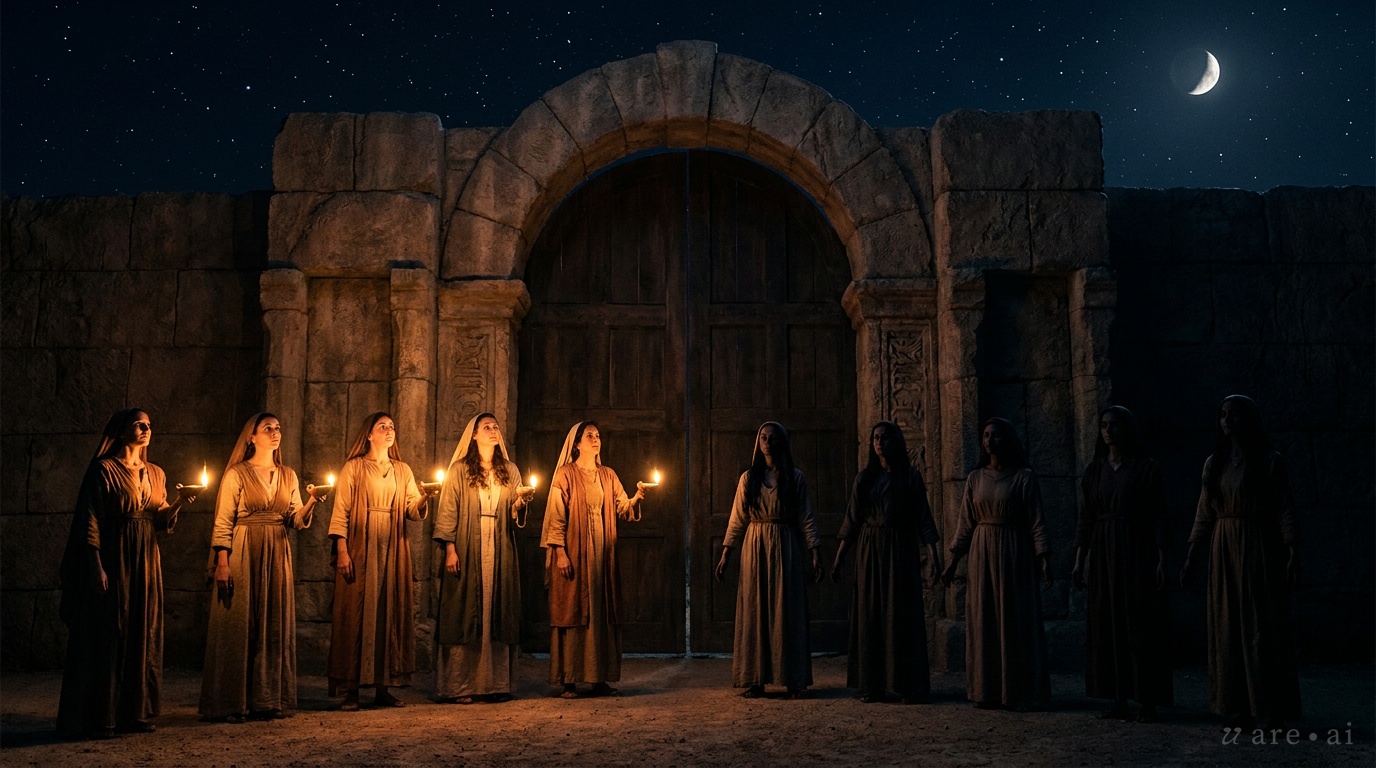
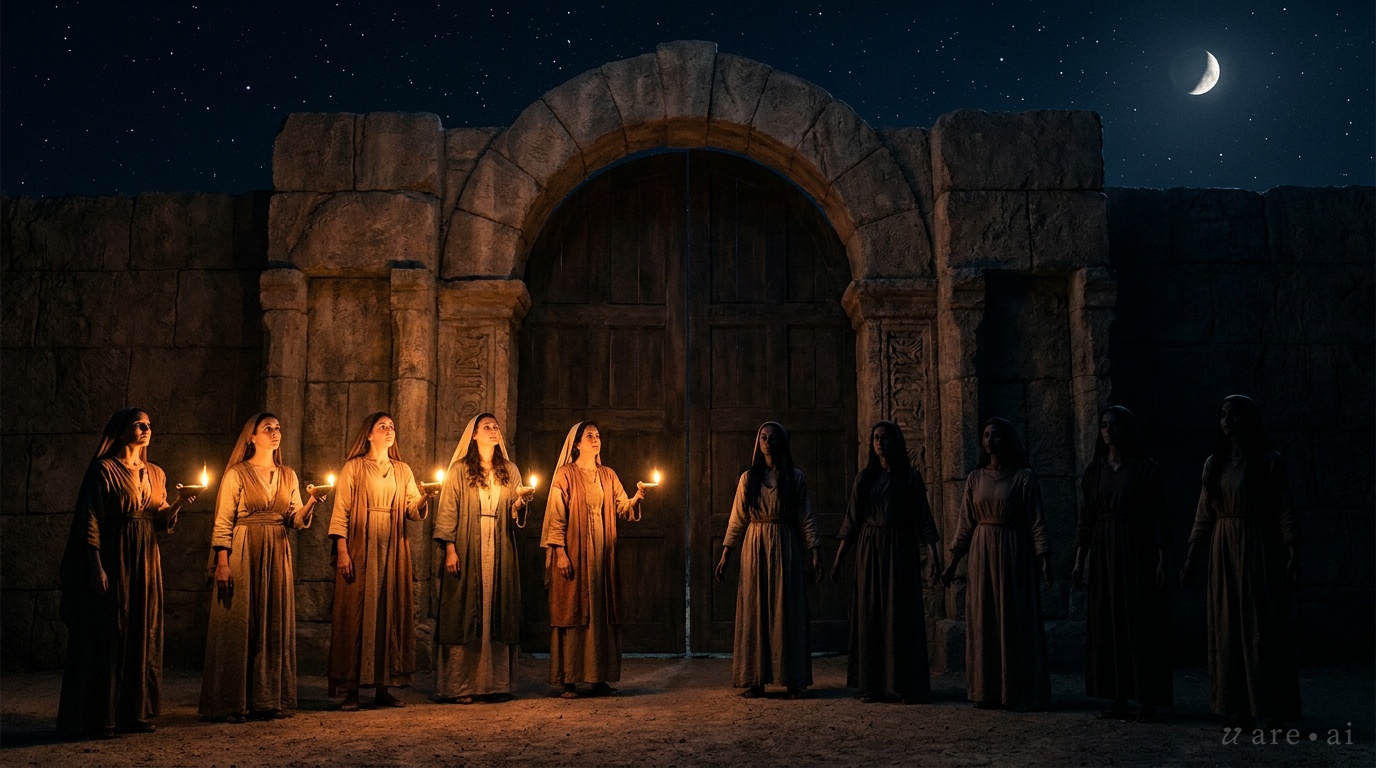
The Ten Virgins
A deep, verse-by-verse study of the Parable of the Ten Virgins in Matthew 25:1–13 KJV, using the Three Era Framework — William Miller and 1844, Preparation Time NOW, and the Second Coming — so that every student moves from head knowledge to experiential oil, from profession to possession, and from sleeping to watching.
▶ Listen to this teaching
The Ten Virgins
Study Outline
- Day 1 — The Kingdom, the Virgins, and the Lamp (Matthew 25:1).
- Day 2 — The Oil That Cannot Be Borrowed (Matthew 25:2–4) — the Spirit that cannot be transferred.
- Day 3 — The Midnight Cry and 1844 (Matthew 25:5–6) — the Great Awakening.
- Day 4 — The Foolish Virgins: Form Without Power (Matthew 25:7–9).
- Day 5 — The Wise Virgins: Character Settled Into Truth (Matthew 25:10).
- Day 6 — The Shut Door: The Close of Probation (Matthew 25:11–12).
- Day 7 — The Bridegroom Cometh: The Second Coming (Matthew 25:13).
The Ten Virgins — Are You Ready?
A 7-Day Deep Study in Matthew 25:1–13
Target Audience: Seventh-day Adventist Church Members and Ministers
Three Era Framework: William Miller / 1844 | Preparation Time NOW | The Second Coming
How to Use This Study
This study follows the same proven 7-layer structure used in the Zechariah 4 Holy Spirit Flow Study. Each day moves deeper into one dimension of the parable, building from the parable's setting to its ultimate fulfillment at the Second Coming. It is designed for both personal devotion and group study.
For Members: Focus on the personal application sections — what this means for your daily walk and character preparation.
For Ministers: Focus on the ministerial application sections — what this means for how you lead, preach, and prepare your congregation.
Important Note: Ellen G. White is emphatic — this parable 'has a special application to this time, and, like the third angel's message, has been fulfilled and will continue to be present truth till the close of time.' — RH August 19, 1890
Table of Contents
Day 1 — The Kingdom, the Virgins, and the Lamp | Matthew 25:1
Day 2 — The Oil That Cannot Be Borrowed | Matthew 25:2–4
Day 3 — The Midnight Cry and 1844 | Matthew 25:5–6
Day 4 — The Foolish Virgins — Form Without Power | Matthew 25:7–9
Day 5 — The Wise Virgins — Character Settled Into Truth | Matthew 25:10
Day 6 — The Shut Door — The Close of Probation | Matthew 25:11–12
Day 7 — The Bridegroom Cometh — The Second Coming | Matthew 25:13
DAY 1 — The Kingdom, the Virgins, and the Lamp
Anchor Text: Matthew 25:1 KJV
"Then shall the kingdom of heaven be likened unto ten virgins, which took their lamps, and went forth to meet the bridegroom."
Word Study
Kingdom of Heaven (Greek: basileia ton ouranon) — Not a political or earthly dominion. Jesus answered the Pharisees directly: 'The kingdom of God cometh not with outward show... for, behold, the kingdom of God is within you.' (Luke 17:20–21). The kingdom begins in the transformed heart. This is the very first word of the parable and it sets the entire frame. This is NOT about the world — it is about those who profess to be waiting for Jesus.
Virgins (Greek: parthenoi) — Pure, set apart, professing ones. These are not the world. These are church members. All ten have made a profession of faith. All ten went out to meet the Bridegroom. The ten virgins represent the entire visible professing church in the last days.
Lamps (Greek: lampades) — Torches, not small oil vessels. These were carried publicly. The lamp represents the Word of God — 'Thy word is a lamp unto my feet.' (Psalm 119:105). Both the wise and the foolish carry the same lamp — the same Bible, the same truth, the same doctrines. The difference is not the lamp. The difference is the oil.
Bridegroom (Greek: nymphios) — Christ Himself. The bridal metaphor runs from the Old Testament through Revelation. He is coming. The question is not whether He will come — it is whether we will be ready.
## Chain References — Day 1
Matthew 25:1 → Psalm 119:105 — The lamp is the Word of God. The virgins carry the lamp, but the lamp without oil is dark. Scripture interprets Scripture: the lamp without the Spirit is doctrine without transformation.
Matthew 25:1 → Revelation 19:7–8 — The Bridegroom is Christ. The marriage of the Lamb has come and His wife has made herself ready. The readiness of the bride is the character of the saints — righteousness not borrowed but individually wrought.
Matthew 25:1 → Zechariah 4:2–6 — The lampstand of Zechariah 4 is the same as the lamp of Matthew 25. The oil flows from the Throne through the olive trees and pipes into the bowl and into the lamp. Without continuous oil supply the lamp goes dark. Ellen White: 'The oil is a symbol of the Holy Spirit.' — COL 406.
Matthew 25:1 → Revelation 14:6–12 — The three angels' messages are the midnight cry sounding in the last days. The SDA church is specifically called to proclaim this cry. The ten virgins ARE the Adventist people — all professing, all waiting, not all prepared.
Matthew 25:1 → Luke 17:20–21 — 'The kingdom of God is within you.' The kingdom of heaven in the parable is the inward kingdom — heart transformation, not church membership. The virgins who are not ready show that outward profession is not the same as inward possession.
## Teaching Points — Day 1
1. The parable addresses church members — not the world. All ten virgins profess faith, carry the lamp, and wait for Jesus. The problem is internal, not external. This is the most uncomfortable truth of the parable for the SDA church.
2. The lamp is the Word of God (Psalm 119:105). Both the wise and foolish carry it. The issue is never doctrine known in the head — it is the oil of the Holy Spirit forming character in the heart. A church can be doctrinally correct and spiritually dead.
3. The Bridegroom is delayed — and the delay is prophetic. The Millerite movement experienced this. The SDA church has been in the delay period since 1844. The delay does not cancel the arrival. It tests the depth of preparation.
4. Ellen White's statement that 'not one in twenty' church members is prepared is not an exaggeration — it is a prophetic warning directed at the SDA church specifically. The minister must take it personally before applying it congregationally.
5. The three era framework is essential: 1844 was the first fulfillment. The NOW is the ongoing fulfillment in every SDA congregation. The Second Coming is the final and irrevocable fulfillment. The parable lives across all three periods simultaneously.
Three Era Framework — Day 1
William Miller / 1844: The parable was first broadly applied during the Millerite movement. Tens of thousands went forth to meet the Bridegroom. They carried their lamps — the prophecies of Daniel 8:14 — and went out in expectation. Both the wise and the foolish were in that movement. 1844 was the first fulfillment of the Midnight Cry.
Preparation Time NOW: EGW makes it unmistakably clear — 'not one in twenty whose names are registered upon the church books are prepared to close their earthly history.' (ChS 41.1). We are the virgins. The question is: wise or foolish? This parable is being fulfilled in every SDA church right now. PROVE THE SDA CHURCH CONNECTION
The Second Coming: The ultimate fulfillment. When the Bridegroom comes, the door shuts. There is no second chance once probation closes. The parable ends in finality — five enter, five do not. This is the most sobering reality in the New Testament.
Ellen G. White Block — Day 1
"It is a solemn statement that I make to the church, that not one in twenty whose names are registered upon the church books are prepared to close their earthly history, and would be as verily without God and without hope in the world as the common sinner. They are professedly serving God, but they are more earnestly serving mammon. This half-and-half work is a constant denying of Christ, rather than a confessing of Christ."
— Ellen G. White, Christian Service, p. 41"The ten virgins are watching in the evening of this earth's history. All claim to be Christians. All have a call, a name, a lamp, and all claim to be doing God's service. All apparently watch for His appearing. But five are wanting. Five will be found surprised, dismayed, outside the banquet hall."
— Ellen G. White, Maranatha, p. 54 (RH October 31, 1899)"This parable has been and will be fulfilled to the very letter, for it has a special application to this time, and, like the third angel's message, has been fulfilled and will continue to be present truth till the close of time."
— Ellen G. White, RH August 19, 1890, par. 3
Application — For Members
You carry a lamp — you have the Bible, you attend church, you know the three angels' messages. But does your lamp burn with the oil of the Holy Spirit? Church membership is not salvation. Doctrine known in the head is not character formed in the heart. Today, ask yourself honestly: Am I a virgin who has the lamp only, or a virgin whose lamp is burning?
Application — For Ministers
Ellen White's indictment in ChS 41 is directed at the church — which means it is directed at its leadership. If not one in twenty in your congregation is prepared, what does that say about the preaching they have heard? The minister must first examine his own lamp before he calls the congregation to examine theirs. The Bridegroom is coming. Are you preparing people for His arrival, or simply managing their attendance?
Discussion Questions — Day 1
1. All ten virgins went out to meet the Bridegroom. What does this tell us about who the parable is addressing?
2. Ellen White says not one in twenty church members is prepared. How does that statement land in your spirit? Do you believe it? Why or why not?
3. What is the difference between carrying the lamp and having oil in your vessel? Give a practical, personal example.
4. In what ways does the church today parallel the Millerite movement of 1844? What can we learn from their experience?
Prayer Focus — Day 1
Lord, I do not want to be among the five who are shut out. Search my heart today. Show me the true condition of my spiritual life. I do not want a lamp without oil. I do not want religion without transformation. Let Your Spirit examine every corner of my character and reveal what needs to change. I surrender to You today. Amen.
Memory Verse — Day 1
"Then shall the kingdom of heaven be likened unto ten virgins, which took their lamps, and went forth to meet the bridegroom." — Matthew 25:1 KJV
DAY 2 — The Oil That Cannot Be Borrowed
Anchor Text: Matthew 25:2–4 KJV
"And five of them were wise, and five were foolish. They that were foolish took their lamps, and took no oil with them: But the wise took oil in their vessels with their lamps."
Word Study
Wise (Greek: phronimos) — Prudent, practically wise, exercising forethought. Not academically brilliant — practically prepared. The wise virgin is not the one who knows the most theology. She is the one who acted on what she knew and prepared while there was still time.
Foolish (Greek: moros) — Root of the English word 'moron.' Not evil — simply without spiritual forethought. The foolish virgin is not a hypocrite or a fraud. She is genuinely in the company of the waiting church. But she did not prepare. She assumed the oil would be there when she needed it.
Oil (Greek: elaion) — Olive oil, the universal symbol of the Holy Spirit throughout Scripture. In Zechariah 4 the oil flows continuously from the two olive trees through golden pipes into the bowl and into the lamps. The oil in Matthew 25 is that same Holy Spirit — not doctrine known in the head, but character formed in the heart by the indwelling Spirit. This oil cannot be given from one person to another. It must be individually received.
Vessels (Greek: aggeia) — Containers, receptacles. The wise virgins brought extra containers of oil. This is the picture of a heart continually open, continually surrendered, continually receiving the Spirit. The vessel represents the character — the inner spiritual life that must be cultivated daily, not borrowed in the last moment.
## Chain References — Day 2
Matthew 25:2–4 → Zechariah 4:6 — 'Not by might nor by power but by My Spirit.' The oil in Matthew 25 is the same oil in Zechariah 4. It flows from God's throne through the two olive trees. It cannot be manufactured, earned, or borrowed. It is received through surrender and daily connection.
Matthew 25:3–4 → 2 Timothy 3:5 — 'Having a form of godliness but denying the power thereof.' The foolish virgin is the exact picture Paul paints in 2 Timothy. She has the form — the lamp, the doctrine, the church attendance. She denies the power — the indwelling Holy Spirit transforming character.
Matthew 25:4 → John 3:5–6 — 'Except a man be born of water and of the Spirit he cannot enter the kingdom of God.' The extra oil in the vessel is the new birth — not a one-time event but a continuous experience of the Spirit dwelling within. The wise virgin maintains this connection daily.
Matthew 25:4 → Galatians 5:22–23 — The fruit of the Spirit is the evidence of the oil. Love, joy, peace, longsuffering, gentleness, goodness, faith, meekness, temperance. These are not manufactured by human effort. They are the overflow of a vessel filled with the Spirit.
Matthew 25:9 → Ezekiel 14:14 — 'Though these three men, Noah, Daniel, and Job were in it, they should deliver but their own souls.' Even the righteousness of the most holy man cannot be transferred. Character is non-transferable. The oil of the Holy Spirit must be individually received, individually maintained.
## Teaching Points — Day 2
1. The oil represents the Holy Spirit forming the character of Christ within the believer — not doctrine memorized, not attendance maintained, not offerings given. It is the inward transformation that only the Holy Spirit can produce through surrender, prayer, and study of the Word.
2. The foolish virgin is not a hypocrite. She genuinely believed she was ready. This is the most dangerous spiritual condition — assuming that because you have the lamp (truth, doctrine, church membership) you have the oil. Ellen White calls this the Laodicean delusion: 'I am rich and increased with goods and have need of nothing.' — Revelation 3:17.
3. The extra vessels represent a heart enlarged through daily devotion — prayer, Bible study, surrender, and service. Character cannot be built overnight. The wise virgin prepared during the delay. The foolish virgin assumed the delay meant there was still time to prepare when the cry came.
4. After 1844 the Great Disappointment exposed who had oil and who did not. Those who held to their faith and searched the Scriptures more deeply became the foundation of the SDA church. Those who fell away had the lamp but not the oil. The same division is happening now within Adventism.
5. The minister's application is sobering: you cannot preach what you do not possess. A minister without oil in his own vessel preaches from an empty lamp. He may have the words but not the power. Ellen White's statement in Testimonies to Ministers p. 188 is direct: the minister must himself be a filled vessel before he can fill others.
The Oil That Cannot Be Borrowed — Deep Interpretation
This is the most critical theological truth of the entire parable. When the foolish virgins said to the wise, 'Give us of your oil,' the answer was no — not because the wise were unkind, but because character cannot be transferred. A minister's faith cannot save his congregation. A parent's relationship with Jesus cannot substitute for the child's own. A church's history cannot replace the member's personal surrender.
The oil represents the righteousness of Christ wrought into the character through years of surrender, prayer, and yielding to the Holy Spirit. It is the fruit of a living, consistent relationship with God. It cannot be manufactured at the last moment. It cannot be purchased or borrowed. This is the crisis of the foolish virgin — she discovers her need too late.
Connection to Zechariah 4
Ellen White explicitly connects Matthew 25 and Zechariah 4 in Christ's Object Lessons pages 406–408. She states: 'The oil is a symbol of the Holy Spirit. Thus the Spirit is represented in the prophecy of Zechariah.' The golden pipes of Zechariah 4 are the channels of the Holy Spirit flowing into each individual lamp. The foolish virgin's pipe is blocked — not by malice but by neglect, self-satisfaction, and the Laodicean condition of feeling rich and in need of nothing.
Three Era Framework — Day 2
William Miller / 1844: After the Great Disappointment, the division between the wise and foolish became clear. Those who had truly received the oil of the Spirit emerged from 1844 with deeper faith and went on to found the Adventist movement. Those who had only the lamp of prophecy without the oil of surrender fell away. The oil was the difference.
Preparation Time NOW: The SDA church today is in the identical position. We have the lamp — the Sabbath, the health message, the Spirit of Prophecy, the Three Angels' Messages. But is the oil flowing? Is the character being formed? The daily surrender, the morning hour with God, the consistent prayer life — these are the vessels being filled.
The Second Coming: When the Bridegroom comes, the time for filling is over. Revelation 22:11 — 'He that is unjust, let him be unjust still... he that is holy, let him be holy still.' The character is sealed at the close of probation. The oil either is there or it is not.
Ellen G. White Block — Day 2
"We all need to study as never before the parable of the ten virgins. Five of them were wise, and five were foolish. The wise took oil in their vessels with their lamps... The oil is a symbol of the Holy Spirit."
— Ellen G. White, 4BC 1179.6; Christ's Object Lessons, p. 406"Be not like the foolish virgins, who take for granted that the promises of God are theirs, while they do not follow the injunctions of Christ. Christ teaches us that profession is nothing. 'If any man will come after me,' He says, 'let him deny himself, and take up his cross daily, and follow me.'"
— Ellen G. White, Maranatha, p. 54"There are many who will not remain at the feet of Jesus, and learn of Him. They have not a knowledge of His ways; they are not prepared for His coming. They have made a pretense of waiting for their Lord. They have not watched and prayed with that faith which works by love and purifies the soul. They have lived a life of carelessness. They have heard and assented to the truth, but they have never brought it into their practical life. The oil of grace is not feeding their lamps, and they are not prepared to enter into the marriage supper of the Lamb."
— Ellen G. White, RH October 31, 1899
Application — For Members
You cannot borrow your spouse's devotional life. You cannot rely on your pastor's anointing. You cannot coast on your parents' faith. The oil is personal. The question today is not 'Am I in the church?' but 'Am I in Christ?' Is your character being formed daily in His presence? The time to fill the vessel is now — not when the cry goes out at midnight.
Application — For Ministers
The minister is the golden bowl in Zechariah 4 — the vessel that receives oil from above and distributes it to the lamps. But if the minister's own vessel is not filled, he has nothing to give. A minister preaching without the anointing of the Holy Spirit is a lamp without oil — it creates form but no light. Your first priority every single day must be your own vessel. Fill it. Then pour.
Discussion Questions — Day 2
1. Why can't the oil be shared between the wise and foolish virgins? What does this reveal about the nature of genuine spiritual preparation?
2. What are the practical daily habits that fill the vessel with oil? What are the habits that drain it?
3. Ellen White says 'the oil of grace is not feeding their lamps.' What specific things in modern SDA church life might be causing this blockage?
4. How does the Zechariah 4 flow connect to what is happening — or not happening — in your own spiritual life right now?
Prayer Focus — Day 2
Lord, I cannot borrow anyone else's oil. I need my own. I acknowledge that I cannot manufacture it, earn it, or produce it by willpower. I open my vessel to You right now. Fill me with the Holy Spirit. Make my character, not just my doctrine. Form Christ in me. I want to be ready when the cry goes forth. Amen.
Memory Verse — Day 2
"But the wise took oil in their vessels with their lamps." — Matthew 25:4 KJV
DAY 3 — The Midnight Cry and 1844
Anchor Text: Matthew 25:5–6 KJV
"While the bridegroom tarried, they all slumbered and slept. And at midnight there was a cry made, Behold, the bridegroom cometh; go ye out to meet him."
Word Study
Chain References — Day 3
- Matthew 25:5–6 → Daniel 8:14 — 'Unto two thousand and three hundred days; then shall the sanctuary be cleansed.' The Midnight Cry IS the fulfillment of this prophecy. The cry of 1844 is the prophetic clock striking midnight. Scripture interprets Scripture: the Bridegroom's delay is measured in prophecy, not in accident.
- Matthew 25:6 → Revelation 14:6–8 — The First and Second Angels' Messages ARE the Midnight Cry. 'Fear God and give glory to Him... Babylon is fallen.' The Millerites proclaimed this. The SDA church carries this same cry forward into the Loud Cry of Revelation 18.
- Matthew 25:5 → Revelation 3:14–17 — The slumber of the virgins is the Laodicean condition. 'Thou art lukewarm.' The church that says 'I am rich and increased with goods' is the church asleep at midnight. The Midnight Cry is the antidote to Laodicea.
- Matthew 25:6 → Isaiah 52:1–2 — 'Awake, awake, put on thy strength, O Zion.' The midnight cry is the divine call to awaken from spiritual slumber. Isaiah's call to Zion is the same call the angel makes at midnight — arise, for the Bridegroom cometh.
- Matthew 25:5–6 → Great Controversy, p. 393 — EGW confirms that the parable's midnight cry was 'fulfilled in the advent movement of 1844.' The history of 1844 is not a closed chapter — it is the prophetic pattern for the final Loud Cry still to come.
Teaching Points — Day 3
1. The delay of the Bridegroom is not a failure of prophecy — it is a test of character. Every SDA believer must understand that the tarrying since 1844 is prophetically designed to reveal what is truly in the heart. Delay exposes the foolish and refines the wise.
2. The Midnight Cry of 1844 had three prophetic dimensions: it was a historical event (the Millerite movement), an ongoing reality (the Three Angels' Messages being proclaimed by the SDA church), and a future climax (the Loud Cry of Revelation 18 with the Fourth Angel's glory). All three must be taught together.
3. ALL TEN virgins slept during the tarrying — both the wise and the foolish. This is one of the most convicting truths in the parable. Even those who are prepared can slip into spiritual drowsiness during a prolonged delay. Daily renewal of the oil is not optional. It is survival.
4. The Midnight Cry is a shout — krauge gegonen — a proclamation that demands an immediate, decisive response. There is no middle ground when the cry goes forth. The lamp either burns or it does not. The minister must preach with this urgency: the cry is not a suggestion, it is a summons.
5. The SDA church is uniquely positioned in prophetic history as the people who carry the Midnight Cry. This is not a matter of pride — it is a matter of solemn accountability. Ellen White: 'The great day of the Lord is near, it is near, and hasteth greatly.' The slumbering church must hear its own prophetic identity before it can sound the cry to the world.
Tarried (Greek: chronizo) — To delay, to take time. The Bridegroom did not come when expected. This is the precise fulfillment of the 1844 disappointment. The disciples expected Christ to return much earlier. The delay was itself prophesied — Habakkuk 2:3: 'For the vision is yet for an appointed time, but at the end it shall speak, and not lie; though it tarry, wait for it; because it will surely come, it will not tarry.'
Slumbered and Slept (Greek: enystaxan kai ekatheudaon) — Two words. Enystaxan means to nod off — a light dozing. Ekatheudaon means to fall into deep sleep. ALL ten virgins did both. This is the Laodicean condition. The entire church — both wise and foolish — fell into spiritual drowsiness during the long waiting period. The wise were not immune to the delay's effect. But they had oil in their vessels when they woke.
Midnight (Greek: mesas nuktos) — The darkest hour. Spiritually, the midnight cry comes at the moment of greatest spiritual darkness, greatest worldly pressure, and greatest complacency in the church. It is the final warning before the door shuts.
A Cry Was Made (Greek: krauge gegonen) — A shout, a loud proclamation. This is not a whisper. This is the Loud Cry of Revelation 18:1 — an angel coming down with great power, and the earth being lightened with his glory. The Midnight Cry is the final proclamation before probation closes.
The 1844 Fulfillment — Deep Historical Analysis
The Millerite movement is the first prophetic fulfillment of Matthew 25. William Miller and his associates proclaimed based on Daniel 8:14 that Christ would return around 1844. The movement spread across all denominations — these were the ten virgins going out to meet the Bridegroom. In the summer of 1844, Samuel Snow proclaimed the Seventh Month message — the Midnight Cry — with electrifying power. Tens of thousands were awakened. On October 22, 1844, the expected date came... and passed.
The Great Disappointment was not a failure of prophecy. It was a test of character. Christ did not come to earth — He moved from the Holy Place to the Most Holy Place in the heavenly sanctuary. The investigative judgment began. The Bridegroom had indeed come — but to the wedding, not yet to gather His bride. The wise virgins — those with the oil of genuine surrender — understood this by the Spirit and emerged with deeper conviction. The foolish fell away.
Three Era Framework — Day 3
William Miller / 1844: This is the primary historical fulfillment of this verse. The Midnight Cry of 1844 was literal, loud, and specific. It separated those with oil from those without. The SDA church was born out of those who heard the cry and responded with genuine faith.
Preparation Time NOW: The Laodicean condition of the church today is the 'slumbering and sleeping' of our era. The cry is coming again. Ellen White says the Midnight Cry will be repeated in the context of the Loud Cry of Revelation 18. The Third Angel's Message swells into the Loud Cry. Are we awake and ready to both hear it and proclaim it?
The Second Coming: The final midnight cry is the close of probation announcement. When the last soul has made their final decision, the decree of Revelation 22:11 is pronounced. The Bridegroom has come. The door is shut. This is not a drill.
Ellen G. White Block — Day 3
"The angels are holding the four winds, represented as an angry horse seeking to break loose and rush over the face of the whole earth. But the work of our High Priest must be finished before the plagues shall fall upon the guilty. We are in a great and solemn hour. Every soul should be earnestly seeking to know what is truth."
— Ellen G. White, Maranatha, p. 36"In the parable, the ten virgins had lamps, but only five of them had the saving oil with which to keep their lamps burning. This represents the condition of the Church. The wise and the foolish have their Bibles, and are provided with all the means of grace; but many do not appreciate the fact that they must have the heavenly unction."
— Ellen G. White, RH August 19, 1890, par. 3"The class represented by the foolish virgins have been content with a superficial work. They do not know God. They have not studied His character; they have not held communion with Him; therefore they do not know how to trust, how to look and live."
— Ellen G. White, Christ's Object Lessons, p. 411
Application — For Members
The Millerites were sincere, faithful, and devoted — and they still slept. Sincerity is not enough to keep the lamp burning through a long delay. What keeps you awake during the tarrying? Is it your personal relationship with Christ? Is it the daily renewal of the oil? The delay is ending. The cry is coming. Do not be found asleep when it does.
Application — For Ministers
The Midnight Cry is the Loud Cry of Revelation 18 — and ministers are the ones commissioned to proclaim it. But you cannot proclaim what you have not experienced. The Millerite ministers who had genuine oil in their vessels proclaimed with power that moved tens of thousands. Study the 1844 movement not as history but as your prophetic assignment. The cry must go forth again, and it must go forth from an anointed ministry.
Discussion Questions — Day 3
1. Why did ALL ten virgins slumber and sleep? What does this tell us about the danger of spiritual complacency even among the prepared?
2. How did the 1844 experience separate the wise from the foolish virgins in the Millerite movement? What lessons should we draw from that?
3. In what ways is the SDA church today in a 'slumbering' condition? What would it look like to be fully awake?
4. The Midnight Cry was proclaimed at midnight — the darkest hour. How does spiritual darkness actually create the conditions for the Loud Cry to go forth with power?
Prayer Focus — Day 3
Lord, wake me up. I do not want to be found sleeping when the cry goes forth. The delay has been long and I confess I have grown drowsy. Awaken my soul. Restore the urgency of Your coming to my heart. I want to hear the cry and respond — with oil in my vessel, with my lamp burning bright. Come quickly, Lord Jesus. Amen.
Memory Verse — Day 3
"And at midnight there was a cry made, Behold, the bridegroom cometh; go ye out to meet him." — Matthew 25:6 KJV
DAY 4 — The Foolish Virgins: Form Without Power
Anchor Text: Matthew 25:7–9 KJV
"Then all those virgins arose, and trimmed their lamps. And the foolish said unto the wise, Give us of your oil; for our lamps are gone out. But the wise answered, saying, Not so; lest there be not enough for us and you: but go ye rather to them that sell, and buy for yourselves." — Matthew 25:7–9
Word Study
Trimmed (Greek: ekosmēsan) — To put in order, to arrange, to adorn. All ten virgins trimmed their lamps at the cry. The word does not mean they had oil — it means they made the outward adjustment. The foolish trimmed what was empty. This is the image of a church that responds to a revival call with external activity but no internal oil. The motion is there. The power is absent.
Gone Out (Greek: sbennuntai) — Present tense: are going out, in the process of dying. The foolish virgins did not suddenly lose their oil at the midnight cry. The oil had been draining slowly throughout the delay. This is the picture of gradual spiritual decline — not a sudden fall but a slow diminishing of the Spirit's presence through neglect, worldliness, and spiritual shallowness.
Give Us (Greek: dote hēmin) — An urgent, desperate demand. The foolish virgins did not ask politely — they demanded what they had not prepared. This is the spirit of spiritual presumption: expecting the transforming grace of God at the last moment without the daily discipline of receiving it. Grace is always available but character cannot be manufactured in a crisis.
Not So (Greek: mēpote) — Lest ever. The wise virgins' refusal is not cruelty — it is spiritual reality. The oil of the Holy Spirit and the character it produces cannot be transferred from one soul to another. Your parent's oil cannot keep your lamp burning. Your pastor's anointing cannot seal your character. Each soul must individually receive from the Source.
Chain References — Day 4
- Matthew 25:8 → 2 Timothy 3:5 — 'Having a form of godliness but denying the power thereof.' This is Paul's precise description of the foolish virgins. The form is there — the lamp, the doctrine, the church attendance — but the power (dunamis) of genuine Spirit transformation is absent. Ellen White connects this directly to the Laodicean condition.
- Matthew 25:9 → Zechariah 4:6 — 'Not by might, nor by power, but by My Spirit.' The oil that the wise virgins carried was the same oil flowing from the Throne through the olive trees and golden pipes of Zechariah 4. You cannot borrow it because it does not originate with any human vessel. It flows directly from God to the individual soul through surrender and faith.
- Matthew 25:8 → Revelation 3:17–18 — 'Because thou sayest, I am rich... and knowest not that thou art wretched, and miserable, and poor, and blind, and naked: I counsel thee to buy of me gold tried in the fire.' The counsel to 'buy' from Christ is the same as the wise virgins' counsel to go buy oil. The transaction is with Christ alone, not borrowed from the church community.
- Matthew 25:7 → Isaiah 58:1 — 'Cry aloud, spare not, lift up thy voice like a trumpet, and show my people their sin.' The foolish virgins represent church members who have never had their true spiritual condition shown to them. The minister who fails to preach the full truth about the crisis of character bears responsibility for the souls who are unprepared.
- Matthew 25:9 → COL 411 — 'The class represented by the foolish virgins have been content with a superficial work. They do not know God. They have not studied His character; they have not held communion with Him.' The oil cannot be borrowed because it IS the relationship. You cannot borrow someone else's relationship with Christ.
Teaching Points — Day 4
1. The foolish virgins are NOT hypocrites — they are the unprepared. EGW is explicit: they are not deliberate deceivers. They are sincere church members who substituted the form of religion for the power of it. This is the most dangerous spiritual condition — sincere, active, doctrinally informed, and spiritually hollow.
2. The oil drains slowly over time through neglect. The foolish virgins did not lose everything in one crisis — they lost it gradually during the long delay. Every time prayer was skipped, every time the Word was set aside for worldly entertainment, every time self was chosen over surrender — the oil drained one drop at a time.
3. Oil cannot be borrowed because character cannot be transferred. The most sobering theological truth in the parable. Your spouse's character cannot save you. Your pastor's anointing cannot seal you. Your Adventist heritage cannot substitute for personal transformation. Each soul must individually and daily receive from the Source.
4. The moment of the cry reveals what has been building for years. The midnight cry does not create the crisis — it reveals it. The lamp that goes dark at the cry was already draining. This is why preparation must happen NOW, in the ordinary days of the delay, not in the extraordinary moment of the crisis.
5. The minister must preach this without softening it. EGW says not one in twenty is prepared. That means the foolish virgins are the majority in the pew. The comfortable sermon that leaves everyone feeling affirmed without examining their oil supply is a disservice to the congregation and a betrayal of the prophetic calling.
Three Era Framework — Day 4
William Miller / 1844: After the Great Disappointment, it became evident who had genuine oil and who had form without power. Those who had truly surrendered to Christ continued in faith. Those who had ridden the wave of excitement without deep personal transformation fell away. The foolish virgins of 1844 were revealed in the aftermath of October 22.
Preparation Time NOW: The SDA church today faces the same crisis. Ellen White warns: 'We are in danger of becoming a sister to fallen Babylon, of allowing our churches to become corrupted.' (Letter 35, 1898). The foolish virgins are sitting in our pews, active in our programs, singing in our choirs — and their lamps are going out. This is the urgent NOW application.
The Second Coming: When the Bridegroom arrives, the foolish virgins are excluded — permanently. 'Go ye to them that sell and buy for yourselves' is the last merciful counsel before the door shuts. But at the Second Coming, there is no more buying. Probation closes. The character is sealed. The oil level at that moment is the oil level for eternity.
Ellen G. White Block — Day 4
"The class represented by the foolish virgins have been content with a superficial work. They do not know God. They have not studied His character; they have not held communion with Him; therefore they do not know how to trust, how to look and live. Their service to God degenerates into a form."
— Ellen G. White, Christ's Object Lessons, p. 411"We are in danger of becoming a sister to fallen Babylon, of allowing our churches to become corrupted and filled with every foul spirit, a cage of every unclean and hateful bird; and this is what we will become if we are not careful and if the Holy Spirit is not poured out upon our people."
— Ellen G. White, Letter 35, 1898"Many who have had great light, who have received the heavenly endowment, will, because of selfishness and a lack of the spirit of sacrifice, allow the oil of grace to become exhausted from their vessels. The flickering light will become more and more dim, and finally it will go out in eternal darkness."
— Ellen G. White, Review and Herald, August 19, 1890
Application — For Members
The foolish virgins were not the world — they were in the church, waiting for Jesus. The question this day forces you to answer is not 'Are you a church member?' but 'Do you know God?' COL 411 defines the foolish virgins not by their sins but by their shallow relationship: they have not studied His character, they have not held communion with Him. Communion is the oil. Study is the pipe. If that channel is blocked, the lamp will go out no matter how many years you have attended church.
Application — For Ministers
Every minister who avoids preaching the hard truths of preparation bears responsibility for the unprepared in his congregation. The foolish virgins were not warned clearly enough. Their lamp going out was not entirely their fault — they sat under preaching that never told them what the oil actually was, how to receive it, and what it looks like when it is draining. Preach the oil. Preach the pipes. Preach the Zechariah 4 connection. Give your people a way to receive, not just a warning that they are empty.
Discussion Questions — Day 4
1. EGW says the foolish virgins 'do not know God.' What does it mean to truly know God versus merely knowing about God? What is the practical difference in daily life?
2. Why can the oil of the Holy Spirit not be borrowed? What does this tell us about the nature of genuine spiritual transformation?
3. The foolish virgins' lamps were going out gradually during the delay. What are the warning signs that oil is draining in a person's spiritual life? What does early-stage spiritual decline look like?
4. EGW warns of the church becoming 'a sister to fallen Babylon.' In what specific ways do you see this danger in the SDA church today?
Prayer Focus — Day 4
Lord, I do not want a form without power. I do not want to be active in Your church while empty in my soul. Search me today and reveal if my lamp is going out. I open every channel of my heart to the flow of Your Spirit. I do not want to be among those who say 'Lord, Lord' and are turned away. Let Your oil fill me to overflowing — not borrowed from anyone else, but received directly from You. Amen.
Memory Verse — Day 4
"Having a form of godliness, but denying the power thereof: from such turn away." — 2 Timothy 3:5 KJV
DAY 5 — The Wise Virgins: Character Settled Into Truth
Anchor Text: Matthew 25:10 KJV
"And while they went to buy, the bridegroom came; and they that were ready went in with him to the marriage: and the door was shut." — Matthew 25:10
Word Study
They That Were Ready (Greek: hai hetoimoi) — The ready ones. Not the perfect ones. Not the sinless ones. The ready ones. Hetoimoi carries the sense of having been prepared in advance, of being in a state of readiness that was achieved through prior process. The wise virgins did not become ready at the cry — they were already ready. Readiness is the result of a sustained, daily process of receiving the oil, not a last-moment emergency.
Went In With Him (Greek: eisēlthan met' autou) — Entered with Him, in His company, as His companions. The Greek preposition meta (with) conveys deep fellowship and intimate companionship. The wise virgins do not merely enter a room — they enter with the Bridegroom. This is the language of relationship. The marriage is not a transaction. It is the culmination of a love relationship that was built during the long delay.
The Door Was Shut (Greek: ekleisthē hē thura) — Aorist passive: was shut, completely, finally. Not ajar. Not to be reopened. The aorist tense indicates a completed, irreversible action. This is the close of probation. The character seal is permanent. The soul that enters the door enters in the character in which they stood at the moment it shut. This is the most sobering four words in the New Testament.
Chain References — Day 5
- Matthew 25:10 → Revelation 22:11 — 'He that is unjust, let him be unjust still: and he which is filthy, let him be filthy still: and he that is righteous, let him be righteous still: and he that is holy, let him be holy still.' The shut door of Matthew 25:10 and the character seal of Revelation 22:11 are the same event. When the door shuts, the character is fixed for eternity.
- Matthew 25:10 → Ezekiel 9:4 — 'Set a mark upon the foreheads of the men that sigh and that cry for all the abominations that be done.' The sealing of the wise virgins corresponds to the mark set on those who mourn over the spiritual condition of the church. The 144,000 of Revelation 7 and 14 are the sealed ones — the wise virgins who endure to the end.
- Matthew 25:10 → Revelation 19:7–8 — 'The marriage of the Lamb is come, and his wife hath made herself ready. And to her was granted that she should be arrayed in fine linen, clean and white: for the fine linen is the righteousness of saints.' The marriage garment is the character of the wise virgins — righteousness not borrowed but individually wrought through daily surrender.
- Matthew 25:10 → GC 621 — EGW on the character seal: 'Now, while our great High Priest is making the atonement for us, we should seek to become perfect in Christ. Not even by a thought could our Saviour be beguiled into sin. Satan finds in human hearts some point where he can gain a foothold... but character that will stand in the time of God’s final test must be formed NOW.' The wise virgins formed it now.
- Matthew 25:10 → Zechariah 4:2, COL 406–408 — The oil in the vessels of the wise virgins IS the Holy Spirit received continuously from the Throne through the olive trees and golden pipes. Ellen White writes: 'The capacity for receiving the holy oil from the two olive trees is increased by receiving and imparting.' (TM 338). The wise virgins kept their capacity growing by giving as well as receiving.
Teaching Points — Day 5
1. Readiness is a state achieved through sustained daily process, not a last-moment crisis decision. The wise virgins were ready BEFORE the cry. The preparation happened during the long, ordinary days of the delay. This is the central practical lesson of the parable: the work of character formation cannot be deferred to a more convenient time.
2. The shut door is the close of probation — and Ellen White confirms it is coming before the Second Coming, not at it. The investigative judgment, the sealing work, and the close of probation all precede the physical return of Christ. The SDA church has a unique prophetic understanding of this sequence. The wise virgins are those whose characters are sealed before that moment arrives.
3. The oil in the vessel is the critical distinction between the wise and the foolish. Both had lamps — the Word of God. Both went out to meet the Bridegroom — they were all in ministry. The distinguishing factor was the extra oil in the vessel: the reservoir of the Holy Spirit built through daily prayer, Bible study, surrender, and service. The vessel IS the character.
4. The marriage is the culmination of a relationship, not the beginning of one. The wise virgins enter WITH the Bridegroom — as those He knows intimately. The most terrifying words in Matthew 25 are not 'the door was shut' but 'I know you not' (v. 12). The shut door is final. But 'I know you not' is the reason. The wise virgins are known because they cultivated the relationship during the delay.
5. The 144,000 are the ultimate expression of the wise virgins. EGW describes them as those 'in whose mouth was found no guile' (GC 649) and who 'follow the Lamb whithersoever he goeth' (Rev. 14:4). They are not sinless in the past — they are characters settled into truth through the power of the indwelling Spirit. This is the goal of the entire 7-day study.
Three Era Framework — Day 5
William Miller / 1844: Those Millerites who had genuine oil — who had truly surrendered to Christ and not merely been swept along by excitement — continued in faith after the Great Disappointment. They became the founding generation of the SDA church. Their continued faithfulness in the aftermath of 1844 is the historical expression of the wise virgins entering with the Bridegroom.
Preparation Time NOW: This is the sealing time. The work being done in the heavenly sanctuary right now — the investigative judgment — is determining whose characters are ready. The SDA church exists in this exact prophetic moment. The wise virgins of today are those who are daily receiving the oil, submitting their characters to Christ's transforming power, and being sealed by the Holy Spirit.
The Second Coming: The wise virgins enter the marriage supper. Revelation 19:9 calls it 'the marriage supper of the Lamb' and pronounces them 'blessed.' The eternal reward of the wise virgin is not merely escape from the plagues — it is the intimate, eternal companionship of the Bridegroom. They enter WITH Him. That is the ultimate destiny of the prepared soul.
Ellen G. White Block — Day 5
"Those who are diligent in business, fervent in spirit will not be found among the foolish virgins. They are preparing now for the coming of the Bridegroom. They are obtaining the oil of grace — not in a spasmodic effort at the last minute, but through a decided, earnest, thorough work of repentance and conversion."
— Ellen G. White, Review and Herald, August 19, 1890"Character that will stand in the time of God's final test must be formed NOW. In the time of trouble, character will not be formed. That work must be done beforehand. Our characters are now being decided for eternity."
— Ellen G. White, The Great Controversy, p. 621"The capacity for receiving the holy oil from the two olive trees is increased by receiving and imparting. The star that shines the brightest is the one that is freely given its light to others."
— Ellen G. White, Testimonies to Ministers, p. 338
Application — For Members
The wise virgin's secret was not superior spiritual talent — it was daily faithfulness. They brought extra oil in their vessels. That extra oil was the accumulated result of morning prayers that could have been skipped, Sabbath worship that could have been casual, and personal Bible study that could have been replaced with entertainment. Every act of faithful receiving increased their vessel's capacity. Today is not the midnight cry — it is the tarrying. Use it. Fill your vessel now.
Application — For Ministers
The minister's calling is to prepare wise virgins — to preach, teach, and model the daily receiving of the oil until the congregation's vessels are full and ready. EGW makes it clear that character is formed NOW, in the ordinary Sabbath sermons and mid-week prayer meetings and personal Bible studies. The minister who fills these ordinary moments with the oil of genuine Spirit-filled teaching is producing wise virgins. The minister who fills them with entertainment, social programs, and motivational talks is producing well-entertained foolish virgins.
Discussion Questions — Day 5
1. EGW says character must be formed NOW — it cannot be formed in the time of trouble. What specific daily practices are you currently building into your life that are forming your character for eternity?
2. The shut door represents the close of probation. How does understanding this prophetic reality change the urgency of your spiritual preparation today?
3. The wise virgins entered WITH the Bridegroom — they were known by Him. What does it mean to be truly known by Christ? How is that different from merely knowing about Him?
4. TM 338 says the capacity for receiving oil is increased by imparting it. How does serving others and sharing your faith actually increase your own spiritual oil supply?
Prayer Focus — Day 5
Lord, I want to be among the wise virgins. Not because I am better, but because I choose to be faithful in the ordinary days of the delay. Let me not waste this tarrying time on things that drain my vessel. Fill me daily with Your Spirit. Form my character through surrender and through service. Let the door find me ready. Let You find me known. Amen.
Memory Verse — Day 5
"And while they went to buy, the bridegroom came; and they that were ready went in with him to the marriage: and the door was shut." — Matthew 25:10 KJV
DAY 6 — The Shut Door: The Close of Probation
Anchor Text: Matthew 25:11–12 KJV
"Afterward came also the other virgins, saying, Lord, Lord, open to us. But he answered and said, Verily I say unto you, I know you not."
Word Study
Afterward (Greek: hysteron) — Later, too late. The word carries the weight of irreversibility. There is no qualifying phrase, no window of mercy attached. It is simply: after. The door is shut and they come after. The timing is the tragedy.
Lord, Lord (Greek: Kyrie, Kyrie) — The double address is significant. In Matthew 7:21–23, Jesus uses the same construction: 'Not every one that saith unto me, Lord, Lord, shall enter into the kingdom of heaven.' The repetition is not reverence in that moment — it is desperation. They know His name. They have used it publicly. But knowing the name is not the same as knowing the Person.
Open to us (Greek: anoixon hemin) — An imperative. They are not requesting. They are demanding entry as if they deserve it. They carried lamps. They waited. They woke up. They trimmed. They came. And yet — the door does not open. Church activity, trimmed lamps, and sincere effort cannot substitute for the oil that was not cultivated before the cry came.
I know you not (Greek: ouk oida hymas) — This is the most terrifying sentence in the New Testament. Oida is not mere acquaintance knowledge — it is deep, intimate knowing. The Bridegroom is not saying He has never heard of them. He is saying: there is no relationship here. No character formed. No oil received. No transformation that only the Holy Spirit produces. You are a stranger to Me.
Chain References — Day 6
Matthew 25:11–12 → Matthew 7:21–23 — 'Lord, Lord' appears in both passages. In Matthew 7, Jesus warns that many will claim works done in His name but will be told 'I never knew you.' The shut door is not sudden judgment — it is the culmination of a life of profession without possession.
Matthew 25:11–12 → Genesis 7:16 — 'And the LORD shut him in.' The door of Noah's ark was shut by God Himself — not by Noah. The shut door of the ten virgins is shut by the Bridegroom — not by human decision. When God shuts a door, no man opens it. (Revelation 3:7)
Matthew 25:11–12 → Revelation 22:11 — 'He that is unjust, let him be unjust still: and he which is filthy, let him be filthy still: and he that is righteous, let him be righteous still.' The close of probation is the moment character is fixed forever. What is formed in the oil-receiving season is what stands in the door-shutting moment.
Matthew 25:11–12 → Ezekiel 9:4–6 — The sealing of God's people precedes the close of probation. Those who sigh and cry for the abominations done in the church receive the mark. Those who do not — do not. The shut door and the seal are two sides of the same event.
Matthew 25:11–12 → Amos 8:11–12 — 'Behold, the days come, saith the Lord GOD, that I will send a famine in the land, not a famine of bread, nor a thirst for water, but of hearing the words of the LORD.' When the door shuts, the voice of mercy ceases. There will be a running to and fro seeking the Word — and finding it not.
Teaching Points — Day 6
1. The shut door is not cruelty — it is consequence. The five foolish virgins were not excluded because God stopped loving them. They were excluded because they did not cultivate the oil that forms character. The door shuts on what was or was not built before it closed.
2. Probation closes for the SDA church specifically before it closes for the world. Ellen White is unmistakably clear: the investigative judgment passes through the names in the church books first. The foolish virgins in the parable are not pagans — they are professed church members whose probation closes at the same moment as everyone else in the church.
3. The National Sunday Law is the final test before the close of probation. EGW in GC 604–606 describes the events: Sunday law enforced, the Loud Cry swells, the seal is given, the plagues begin. The ten virgins who are not sealed at that moment are among the foolish — no matter how long they sat in the church.
4. 'I know you not' is the verdict of character, not of creed. The Bridegroom does not say 'You believed wrongly' or 'You attended the wrong church.' He says there is no relationship. No deep knowing. This is the ultimate indictment of religion without relationship — of doctrine without the Holy Spirit working transformation in the soul.
5. The minister who waits until the Sunday Law comes to prepare his congregation has waited too long. The oil must be in the vessel now — not sought in the crisis. Crisis reveals character; it does not build it. The work of preparation is the work of today.
Three Era Framework — Day 6
William Miller / 1844: The Millerite movement experienced a type of the shut door. October 22, 1844, was the Great Disappointment — but for those who had genuinely received the oil of the Holy Spirit in their characters, the door that shut was not the door of salvation. It was the door of a particular phase of probationary history. The lesson: those who were truly prepared passed through the disappointment with faith intact. Those who were not fell away.
Preparation Time NOW: EGW writes in GC 490: 'The great work of the gospel is not to close with less manifestation of the power of God than marked its opening.' The Loud Cry is sounding now in measure. The oil must be cultivated now. Character must be formed now — in peace — because the coming crisis will not allow time for preparation. The foolish virgins found this out too late. Preparation TIME NOW is the critical window. It will not remain open forever.
The Second Coming — The Final Shut Door: When Christ comes in the clouds, probation is long past closed. The plagues have fallen. The Sunday Law enforced and then dissolved. The seven last plagues have been poured out. The door that closes in Matthew 25:10 is the door of probation at the National Sunday Law. The door that remains shut when the Bridegroom appears is permanent and eternal. Those outside stand there — and He says: I know you not.
Ellen G. White Block — Day 6
"I saw that many were neglecting the preparation so needful and were looking to the time of 'refreshing' and the 'latter rain' to fit them to stand in the day of the Lord and to live in His sight. Oh, how many I saw in the time of trouble without a shelter! They had neglected the needful preparation; therefore they could not receive the refreshing that all must have to fit them to live in the sight of a holy God."
— Ellen G. White, Early Writings, p. 71"When the work of the investigative judgment closes, the destiny of all will have been decided for life or death. Probation is ended a short time before the appearing of the Lord in the clouds of heaven."
— Ellen G. White, The Great Controversy, p. 490"Those who delay a preparation for the day of God cannot obtain it in the time of trouble or at any subsequent time. The case of all such is hopeless."
— Ellen G. White, The Great Controversy, p. 620
Application — For Members
The five foolish virgins did not go to sleep planning to be shut out. They simply put off the work of cultivating oil until it was too late. The shut door teaches us that there is a season for preparation and it has a closing time. You do not know the day or the hour — but you know that the hour is coming. The oil of the Holy Spirit forming character in you is not a crisis preparation. It is a daily, progressive, Spirit-dependent work. Do not sleep through your season.
Application — For Ministers
The minister who knows the parable of the ten virgins and still preaches cheap grace and social religion to his congregation will answer for the souls who stood at the shut door. GC 620 says it plainly: 'Those who delay a preparation for the day of God cannot obtain it in the time of trouble.' Your pulpit has one overriding assignment: prepare people for the shut door by helping them receive the oil now. Doctrine without transformation produces virgins with lamps and no oil. You know what the Bridegroom says to them.
Discussion Questions — Day 6
1. EGW says in Early Writings p. 71 that many were looking to the Latter Rain to fit them to stand, but they had neglected the preparation. How does this apply to the SDA church today? Are we doing the same thing?
2. The Bridegroom says 'I know you not' — not 'you believed wrongly' or 'you sinned too much.' What does this tell us about what the judgment is ultimately based on?
3. If probation closes before the Second Coming, what does that mean for how we think about 'getting right with God later'? How should this truth change the urgency of our spiritual life right now?
4. Noah's door was shut by God (Genesis 7:16). The Bridegroom shuts this door. What does it mean that the shut door is God's act, not man's? How does this truth affect how you relate to the mercy and justice of God?
Prayer Focus — Day 6
Lord, the shut door terrifies me in the best possible way. I do not want to be outside when it closes. I do not want to know Your name without knowing Your presence. I ask You to do the deep work in me now — while the door is still open. Form Your character in me. Let Your Spirit be the oil that fills every empty place. I surrender every delay, every compromise, every excuse. I choose to be among the wise today. Amen.
Memory Verse — Day 6
"But he answered and said, Verily I say unto you, I know you not." — Matthew 25:12 KJV
DAY 7 — The Bridegroom Cometh: The Second Coming
Anchor Text: Matthew 25:13 KJV
"Watch therefore, for ye know neither the day nor the hour wherein the Son of man cometh."
Word Study
Watch (Greek: gregoreite) — The present imperative of gregoreo. It does not mean watch the sky. It means be awake, be alert, be spiritually vigilant. The same word is used in 1 Peter 5:8: 'Be sober, be vigilant; because your adversary the devil, as a roaring lion, walketh about, seeking whom he may devour.' To watch is not passive observation — it is active spiritual preparedness, sustained over time, fueled by the oil that does not run out.
Ye know not the day nor the hour (Greek: ten hemeran oude ten horan) — This is the reason for watching. Ignorance of the timing is not a problem to solve — it is the design of God. If we knew the day, we would prepare on the day. Because we do not know, the only safety is continuous preparation. The oil must be in the vessel always — not stored up in last-minute bursts.
Son of man cometh (Greek: erchetai ho huios tou anthropou) — Present tense used for a future certainty. The Son of man IS coming. It is so certain that the Greek grammar presents it as already in motion. The parable does not end with uncertainty — it ends with certainty. The Bridegroom will come. The wedding will take place. The door will either open for you or it will not. There is no third option.
Chain References — Day 7
Matthew 25:13 → 1 Thessalonians 4:16–17 — 'For the Lord himself shall descend from heaven with a shout, with the voice of the archangel, and with the trump of God.' The Bridegroom who comes in the parable is the Lord who descends in glory. The watching of Matthew 25:13 and the catching up of 1 Thessalonians 4 are the same event from two different vantage points — one in the upper room, one in the epistle.
Matthew 25:13 → Revelation 19:7–9 — 'Let us be glad and rejoice, and give honour to him: for the marriage of the Lamb is come, and his wife hath made herself ready. And to her was granted that she should be arrayed in fine linen, clean and white: for the fine linen is the righteousness of saints.' The wedding of Revelation 19 IS the arrival of the Bridegroom in Matthew 25. The wife made herself ready — she is the wise virgin. Her garment is the righteousness formed by the oil of the Holy Spirit.
Matthew 25:13 → Daniel 12:1–2 — 'And at that time shall Michael stand up, the great prince... and there shall be a time of trouble, such as never was.' The Second Coming is preceded by the time of Jacob's trouble. The wise virgins who watched and were sealed pass through this time with God as their shelter. The foolish virgins are not sealed and have no shelter in that hour.
Matthew 25:13 → Zechariah 4:6 — 'Not by might, nor by power, but by my spirit, saith the LORD of hosts.' The watching of Matthew 25:13 is not human willpower — it is the continuous supply of the Holy Spirit through the golden pipes into the lamp. The watcher who is also a receiver of the oil of the Holy Spirit is the one who is found ready when the Bridegroom comes. The two studies — Zechariah 4 and Matthew 25 — meet here at the Second Coming.
Matthew 25:13 → Revelation 18:1–4 — The Loud Cry of Revelation 18 is the final sounding of the Midnight Cry before the Bridegroom arrives. 'Come out of her, my people.' The wise virgins who heed this cry are sealed and ready. The watching of Matthew 25:13 is ultimately the response to the Loud Cry — come out, be ready, the Bridegroom is near.
Teaching Points — Day 7
1. The conclusion of the parable is not a prophecy of doom — it is an invitation to be among the five who enter. Jesus told this parable not to terrify but to prepare. Every person who hears it has the opportunity to be a wise virgin. The oil is available. The throne pours it through the olive trees and pipes into every vessel willing to receive.
2. The word 'watch' (gregoreite) is the entire practical conclusion of the parable. It means cultivate the oil daily. Read the Word. Pray. Surrender. Confess. Receive. The watcher is not the one staring at prophecy charts — it is the one whose lamp burns because the Spirit is flowing into their vessel today.
3. The Second Coming is not the climax of history for the watching SDA believer — it is the vindication. The long delay is over. The Bridegroom has arrived. The cry has been sounded. The door has already been decided. For the wise, this moment is not terror — it is the fulfillment of everything they cultivated in the quiet seasons of watching and receiving.
4. The SDA church was raised up to proclaim the Midnight Cry. The three angels' messages ARE the Midnight Cry in its final and fullest form. If SDAs do not sound this cry with the oil of the Holy Spirit, who will? The minister who understands Matthew 25:13 in its full prophetic context understands that every Sabbath sermon is preparation for the arrival of the Bridegroom.
5. Zechariah 4 and Matthew 25 are the same message from two different vantage points. The golden oil of Zechariah 4 is the oil of Matthew 25. The seven-branched lampstand of Zechariah 4 is the lamp of every virgin. The Bridegroom of Matthew 25 is the same God who declares in Zechariah 4:6: 'Not by might, nor by power, but by My Spirit.' The entire 14-day study — Zechariah 4 and Matthew 25 — is one message, one call, one urgent preparation.
DAY 7 — The Bridegroom Cometh: The Second Coming
Anchor Verse: Matthew 25:10 — "And while they went to buy, the bridegroom came; and they that were ready went in with him to the marriage: and the door was shut."
Key Texts: Matthew 25:1–13 | Revelation 19:7–9 | 1 Thessalonians 4:16–17 | Revelation 22:11–12
🔑 WORD STUDY
"Bridegroom" (Greek: Nymphios — νυμφίος): The one who comes to claim His prepared bride. In Jewish wedding custom, the bridegroom's arrival was the moment of final, irrevocable union. There was no second chance after the door was shut. Ellen White writes: "The coming of the bridegroom was at midnight — the darkest hour. So the coming of Christ will take the world by surprise." — Christ's Object Lessons, p. 414
"Were ready" (Greek: Hetoimoi — ἕτοιμοι): Prepared, complete, furnished. This is not a passive state — it describes a character fully formed, settled into truth, bearing the seal of God. It is the result of a daily, Spirit-filled walk. The wise did not scramble at the midnight cry; they were already ready.
"The door was shut" (Greek: Ekleisthe — ἐκλείσθη): Aorist passive — the door was decisively, permanently closed. This is the close of probation. Not a gradual fading but a single, solemn moment. Revelation 22:11 — "He that is unjust, let him be unjust still... he that is righteous, let him be righteous still."
🔗 CHAIN REFERENCES
- Matthew 25:10 → Revelation 19:7–9 (The marriage supper of the Lamb — His wife made herself ready)
- Revelation 19:8 → Revelation 3:4–5 (White raiment = righteous acts of the saints; overcomers clothed in white)
- Matthew 25:10 → Revelation 22:11–12 (Close of probation — character fixed; reward comes with Him)
- Matthew 25:13 → Mark 13:32–37 (Watch therefore — no one knows the day or hour; be ready always)
- 1 Thessalonians 4:16–17 → 1 Corinthians 15:51–54 (The last trump — the dead raised, the living changed)
- Revelation 19:9 → Luke 14:15 (Blessed are they that are called to the marriage supper of the Lamb)
- Matthew 25:12 → Luke 13:25–27 ("I know you not" — the shut door is final; character cannot be borrowed)
📌 TEACHING POINTS
Teaching Point 1 — The Marriage Supper Is Real: Revelation 19:7–9 establishes this is not merely symbolic. The Lamb marries His church — those whose robes have been washed and whose character reflects His. The preparation was not ceremonial; it was the actual transformation of the inner life through the Holy Spirit.
Teaching Point 2 — The Shut Door Is the Close of Probation: Ellen White is explicit — this is not a doctrine to be softened. When Christ rises from the sanctuary and declares it is done (Revelation 16:17), probation closes. The foolish virgins represent professed believers who had religion but no inward oil. Their knocking comes too late.
Teaching Point 3 — Readiness Cannot Be Transferred: "I know you not" is among the most sobering words in Scripture. The oil of character — cultivated through surrender, prayer, and the Word — cannot be borrowed at the last moment. What we are when He comes is what we will be forever.
Teaching Point 4 — The Second Coming Is Personal: Every eye shall see Him (Revelation 1:7). This is not a private rapture. It is the open, visible, glorious return of the King. Those who are ready will be caught up to meet Him in the air. Those who are not will be destroyed by the brightness of His coming (2 Thessalonians 2:8).
⏳ THREE ERA FRAMEWORK
ERA 1 — William Miller and 1844: The parable was first fulfilled in the Millerite movement. The midnight cry of Matthew 25:6 was the Second Angel's Message of 1844 — "Babylon is fallen!" The wise virgins trimmed their lamps through deep study of Daniel 8:14. The Great Disappointment was not God's failure; it was the fulfillment of the cleansing of the sanctuary. Those who held steady in faith went forward into the investigative judgment. Those who rejected the message were cut off.
ERA 2 — Preparation Time NOW (2026): We are living in the time between the Millerite awakening and the final midnight cry. The Laodicean condition Ellen White describes — lukewarm, self-satisfied, lacking the oil of genuine conversion — is the SDA church's present danger. NOW is the time to fill our lamps. The National Sunday Law approaches. Character cannot be built overnight. The question is not "will I be ready someday?" but "am I building the oil supply daily?"
ERA 3 — The Second Coming: The final fulfillment of Matthew 25 is the literal return of Christ. When He descends with a shout (1 Thessalonians 4:16), probation is already closed. The wise go in to the marriage. The foolish are left outside — not because God rejected them, but because they had rejected the process of transformation that would have prepared them. Revelation 19:7–9 — His wife made herself ready.
📖 ELLEN WHITE BLOCK
"The class represented by the foolish virgins are not hypocrites. They have a regard for the truth, they have advocated the truth, they are attracted to those who believe the truth; but they have not yielded themselves to the Holy Spirit's working. They have not fallen upon the Rock Christ Jesus, and permitted their old nature to be broken up. This class are represented also by the stony-ground hearers. They receive the word with readiness, but they fail to assimilate its principles." — Ellen G. White, Christ's Object Lessons, p. 411
"The great day of God is right upon us. The signs that He has given are being fulfilled. Prophecy is being fulfilled. More and more the world is being filled with violence. And yet the people of God are asleep. How can they sleep at such a time as this? Those who are watching unto prayer, whose spiritual senses are not deadened by iniquity, will see the signs of the times. But the majority of church members love their ease and pleasure more than they love God." — Ellen G. White, Testimonies to Ministers, p. 428
"When the work of the investigative judgment closes, the destiny of all will have been decided for life or death. Probation is ended a short time before the appearing of the Lord in the clouds of heaven." — Ellen G. White, The Great Controversy, p. 490
"The heavenly intelligences will work with the human agent who seeks with determined faith that perfection of character which will reach out to perfection in action. God can never glorify His name through the people while they are satisfied with a low standard." — Ellen G. White, Christ's Object Lessons, p. 314
👥 DUAL APPLICATION
For Church Members: The ten virgins all look the same on the outside. Same lamps. Same procession. Same profession of faith. The only difference is internal — the oil. Ask yourself honestly: Is my religion a habit or a living relationship? Have I fallen upon the Rock, or am I still standing on my own goodness? The door will shut. The question is which side of it you will be on.
For Ministers: You will stand before God not only for your own soul but for every soul under your care. Ellen White writes that ministers who feed their congregations "cheap fodder" and fail to open the sanctuary truth, the three angels' messages, and the deep things of God will share in the spiritual starvation of their people. Preach the whole truth. Preach the shut door. Preach character preparation. Do not smooth down the sharp edges of this parable.
❓ DISCUSSION QUESTIONS
1. What does "the door was shut" mean to you personally? Does it motivate you or frighten you — and what does your reaction reveal about your spiritual condition?
2. Ellen White says the foolish virgins are not hypocrites. Why is that significant? How does that change your understanding of who is at risk?
3. What specific daily practices would build the "oil" in your lamp right now? What is one thing you could start this week?
4. How does the Three Era Framework — 1844, now, and the Second Coming — change the urgency of how you read Matthew 25?
5. If Christ came today, would you be among the wise or the foolish? Be honest. What one step would change your answer?
🙏 PRAYER FOCUS
Lord, I do not want to be among those who are left outside. I want to be found in You — not in my own righteousness, but in Yours. Fill me with Your Spirit today. Break up my stony ground. Let me not be satisfied with the form of godliness while missing the power. Prepare my character for Your coming. I choose to be ready. In Jesus' name. Amen.
📌 MEMORY VERSE
"Watch therefore, for ye know neither the day nor the hour wherein the Son of man cometh." — Matthew 25:13
BACK MATTER
Master Memory Verse List
- Day 1 — Matthew 25:1 — "Then shall the kingdom of heaven be likened unto ten virgins, which took their lamps, and went forth to meet the bridegroom."
- Day 2 — Matthew 25:4 — "But the wise took oil in their vessels with their lamps."
- Day 3 — Revelation 14:8 — "And there followed another angel, saying, Babylon is fallen, is fallen, that great city."
- Day 4 — 2 Timothy 3:5 — "Having a form of godliness, but denying the power thereof: from such turn away."
- Day 5 — Ezekiel 9:4 — "And the LORD said unto him, Go through the midst of the city... and set a mark upon the foreheads of the men that sigh and that cry for all the abominations that be done in the midst thereof."
- Day 6 — Revelation 22:11 — "He that is unjust, let him be unjust still... he that is righteous, let him be righteous still."
- Day 7 — Matthew 25:13 — "Watch therefore, for ye know neither the day nor the hour wherein the Son of man cometh."
Glossary of Key Terms
Oil — The Holy Spirit; specifically the transforming work of the Spirit in the character. Cannot be borrowed, transferred, or obtained at the last moment. Must be cultivated daily through prayer, the Word, and surrender.
Lamps — The Word of God (Psalm 119:105); also the outward profession of faith. All ten virgins had lamps. The difference was the oil within.
Midnight Cry — The urgent proclamation that the bridegroom is coming. Historically fulfilled in 1844 with the Millerite movement and the Second Angel's Message. Will be fulfilled again in the Loud Cry of Revelation 18:1–4.
Wise Virgins — Those who have not merely professed faith but have been genuinely transformed by the Holy Spirit. Their characters are sealed. They are ready when the cry comes.
Foolish Virgins — Not hypocrites, but unprepared believers. They had religion without transformation. They represent the Laodicean condition: trusting in outward profession while lacking inward spiritual reality.
The Shut Door — The close of probation. The moment Christ finishes His intercessory work in the Most Holy Place and stands up (Daniel 12:1). Character is then fixed for eternity.
The Bridegroom — Jesus Christ, who comes to claim His prepared bride — the church that has made herself ready through righteousness and character transformation.
Investigative Judgment — The pre-Advent judgment that began in 1844 (Daniel 8:14). The books of heaven are opened; each case is reviewed before the Second Coming.
Laodicean Condition — Revelation 3:14–18. Lukewarm, self-satisfied, lacking the gold of faith, the white raiment of righteousness, and the eye salve of discernment. The present condition of the SDA church according to Ellen White.
Teacher's Guide and Facilitator Notes
How to Use This Study
This study is designed for both individual use and group facilitation. Each day builds on the previous one. Do not skip days or rearrange the order — the Three Era Framework depends on cumulative understanding.
For Small Group Leaders:
- Open each session with the memory verse read aloud by the group. Read the anchor verse together. Walk through the Word Study — encourage participants to look up the Greek/Hebrew words using a Strong's Concordance. Use the Chain References as a Bible marking exercise.
- Read the EGW Block aloud. Allow silence after each quote. Let it settle. Do not rush past Ellen White's words.
- Use the Discussion Questions to open honest conversation. The most important question in every day is the personal application: "What does this mean for me specifically?"
- Close with the Prayer Focus. Encourage participants to pray it aloud together.
For Ministers Teaching This Study:
Do not smooth down the hard edges of this study. The shut door is real. The close of probation is real. The Laodicean condition is real. Ellen White was not ambiguous about the danger facing SDA churches. Your people need to hear this truth delivered with love but without compromise.
Recommended Ellen White Reading Plan (Alongside This Study):
- Day 1–2: Christ's Object Lessons, pp. 406–421 (The Parable of the Ten Virgins)
- Day 3: The Great Controversy, pp. 315–330 (The Millerite Movement)
- Day 4: Christ's Object Lessons, pp. 408–414 (The Foolish Virgins)
- Day 5: The Great Controversy, pp. 613–626 (The Seal of God)
- Day 6: The Great Controversy, pp. 490–491 (Close of Probation)
- Day 7: The Great Controversy, pp. 640–652 (The Second Coming)
FINAL CALL TO ACTION
"The Lord is soon to come. We need to be preparing for that event. Oh, let not the days pass by and precious opportunities be lost. Every day we may take steps that will bring us nearer to Jesus or carry us farther from Him. Every day we may advance in knowledge and in holiness, or we may go back toward the darkness and sin of the world." — Ellen G. White, Testimonies for the Church, Vol. 2, p. 355
This study is not academic. It is urgent. The Ten Virgins are not a parable from the distant past. They are a mirror held up to the SDA church today. Look into it honestly. Fill your lamp. Surrender daily. The midnight cry is coming. The only question that matters is this:
Are you ready?
Study developed for Are You Praying Ministries (AYP) | AYP.news